11 min read
CBDC vs Stablecoins: The Differences that Actually Change Your Build
Your board wants a settlement rail named this quarter, and the choice is load-bearing for two years of integration work. Nobody can say whether the pilot you are asked to bet on will ship.
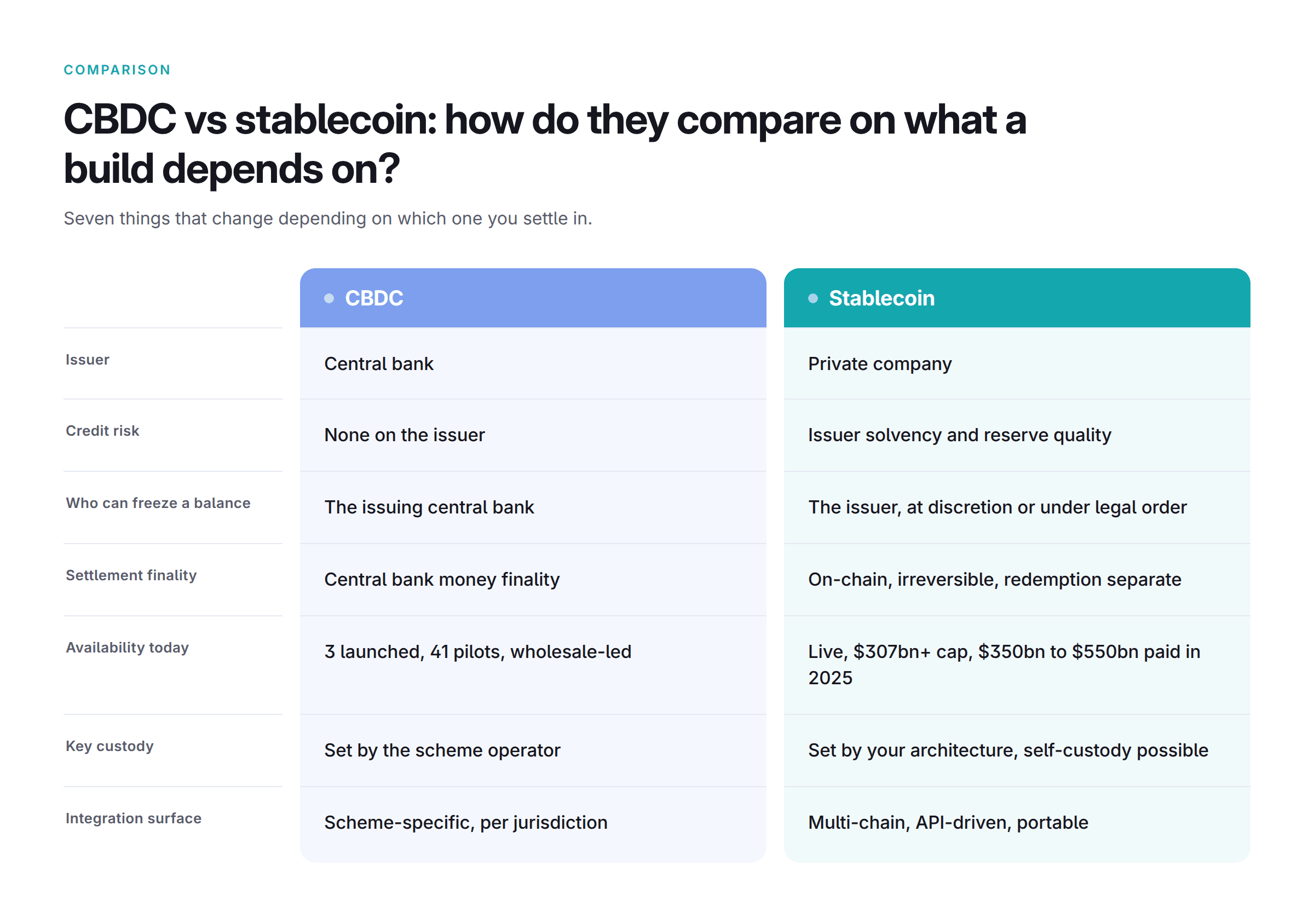
A CBDC is money issued by a central bank, a direct liability on its balance sheet. A stablecoin is a token issued by a private company, backed by reserves it holds and reports on. Most comparisons stop at the issuer. The difference that changes an architecture is control: with either instrument, someone who is not you can freeze a balance, and the only variable you own is who holds the keys.
The Atlantic Council's CBDC tracker counts 146 countries exploring a CBDC and 41 live pilots. BCG and Allium Labs put stablecoin market capitalisation above $307 billion in December 2025, on $350 to $550 billion of real-economy payments. Only one of those is money you can move on Monday.
CBDC vs stablecoin: what is the actual difference?
A CBDC is central bank money in digital form, a direct claim on the central bank. A stablecoin is a private token whose value depends on the issuer's solvency and how its reserves are attested. That matters to your credit committee. It changes almost nothing about your integration surface, the part that costs two years.
Why should a CBDC be taken seriously rather than dismissed?
The case. A CBDC carries no issuer credit risk: a central bank does not default in its own currency, and no private issuer's reserves can match that. Settlement is final in central bank money, which matters on high-value interbank and cross-border legs. The serious institutional work is concentrated in wholesale infrastructure: thirteen cross-border projects, the ECB's Project Pontes, Singapore's wholesale issuance, Brazil's Drex pilot, and mBridge volume at $55.49 billion as of May 2026. e-CNY is the largest, past 3.4 billion retail transactions worth roughly $2.3 trillion by December 2025.
The limit. Three countries have fully launched a CBDC, the Bahamas, Jamaica and Nigeria, all still chasing domestic reach against slow adoption. Every G20 country except the United States is exploring one, 18 at advanced stages and 14 in pilot, while Canada, Australia and Norway have deprioritised retail.
What it means for your build. Outside those three markets and a short list of invited wholesale participants, there is no CBDC you can integrate this year. Attach it later as a scheme. Do not let the prospect of one set your architecture.
Why do stablecoins keep winning the volume?
The case. They clear today. In 2025, B2B payments were about 40% of real-economy stablecoin volume and growing about 65% a year, the segment regional banks and payment institutions serve. That growth came with regulatory clarity, not in spite of it, across the US, Canada, Europe, Singapore and the UAE.
The limit. TRON's share of real-economy payment volume fell from about 74% in January 2025 to about 60% by year end, with growth going to BNB Smart Chain, Ethereum, Solana and Polygon. That is a shift from pure cost minimisation toward a multi-rail interoperable settlement model, and any design that hard-codes one chain is already behind.
What it means for your build. Plan for several chains from day one and treat regulation as a build input. Segregation, safeguarding and reporting duties shape your account structure immediately, the argument in our breakdown of asset segregation under MiCA and our explainer on MiCA and EU stablecoin issuers. Our guide to stablecoin categories maps the instrument set; our dollar-token comparison covers the issuers.
Who can freeze your balance, and does the instrument change that answer?
The case. Circle states its powers plainly in its USDC risk factors, last updated 27 October 2023. Circle "reserves the right to 'block' certain USDC addresses and, if such addresses are Circle custodied addresses, freeze associated USDC (temporarily or permanently) that it determines, in its sole discretion, are associated with illegal activity or activity that otherwise violates the terms of this User Agreement". Circle "may also be forced to freeze USDC and/or surrender associated U.S. Dollars held in Segregated Accounts in the event it receives a legal order from a valid government authority requiring it to do so". A central bank holds the same power over its own liability, by statute rather than user agreement. Programmable central bank money is administered money.
The limit. The freeze axis does not separate the two instruments, and no wallet architecture removes it. Self-custody controls the keys, not the contract.
What it means for your build. What separates outcomes sits below the instrument: who holds the signing key, who approves a withdrawal, and whether that stack survives a change of instrument.
Two programmes name a settlement rail this year. One commits to the instrument: scheme-specific addresses and approvals, one issuer's API. When the pilot slips, it re-integrates from the deposit address up. The other commits to the key-custody model, adds a network, keeps its addresses and approval tiers, and ships in a sprint.
When is a CBDC-first build the right call?
- Your primary flow is wholesale settlement and you are a direct participant in mBridge, Project Pontes or Singapore's wholesale issuance.
- Your credit committee will not accept private issuer exposure at any reserve quality.
- You operate in the Bahamas, Jamaica or Nigeria and domestic reach is the objective.
- Your central bank has invited you into a pilot with a named issuance timetable.
- Your licence requires settlement finality in central bank money.
When is a stablecoin-first build the right call?
- You need to move value in the next two quarters, not after a legislative decision you do not control.
- Your customer flows are B2B cross-border, the segment growing about 65% a year.
- You are licensed or seeking licence in the US, Canada, Europe, Singapore or the UAE.
- Your treasury can carry issuer credit risk and document reserve diligence.
- You need multi-chain coverage, because your counterparties are not all on one chain.
How do you build a rail that survives either outcome?
Own the wallet layer, then attach instruments to it. CoinsDo provides a modular, API-driven Wallet-as-a-Service platform for deposits, withdrawals, approvals and KYC. You keep full control of your private keys, so your assets and addresses stay usable even if the partnership ends.
CoinGet generates deposit addresses on demand, screens the counterparty's sending address for KYT risk before funds land, and sweeps balances to collection on rules you set.
CoinSend runs withdrawals through custom approval flows with reviewer tiers, thresholds and escalation for high-value transactions. Approvals are signed by CoinSign, whose Bank-Grade Digital Signatures (RSA, HMAC-SHA256) make each approval tamper-proof and leave an unforgeable authorization trail.
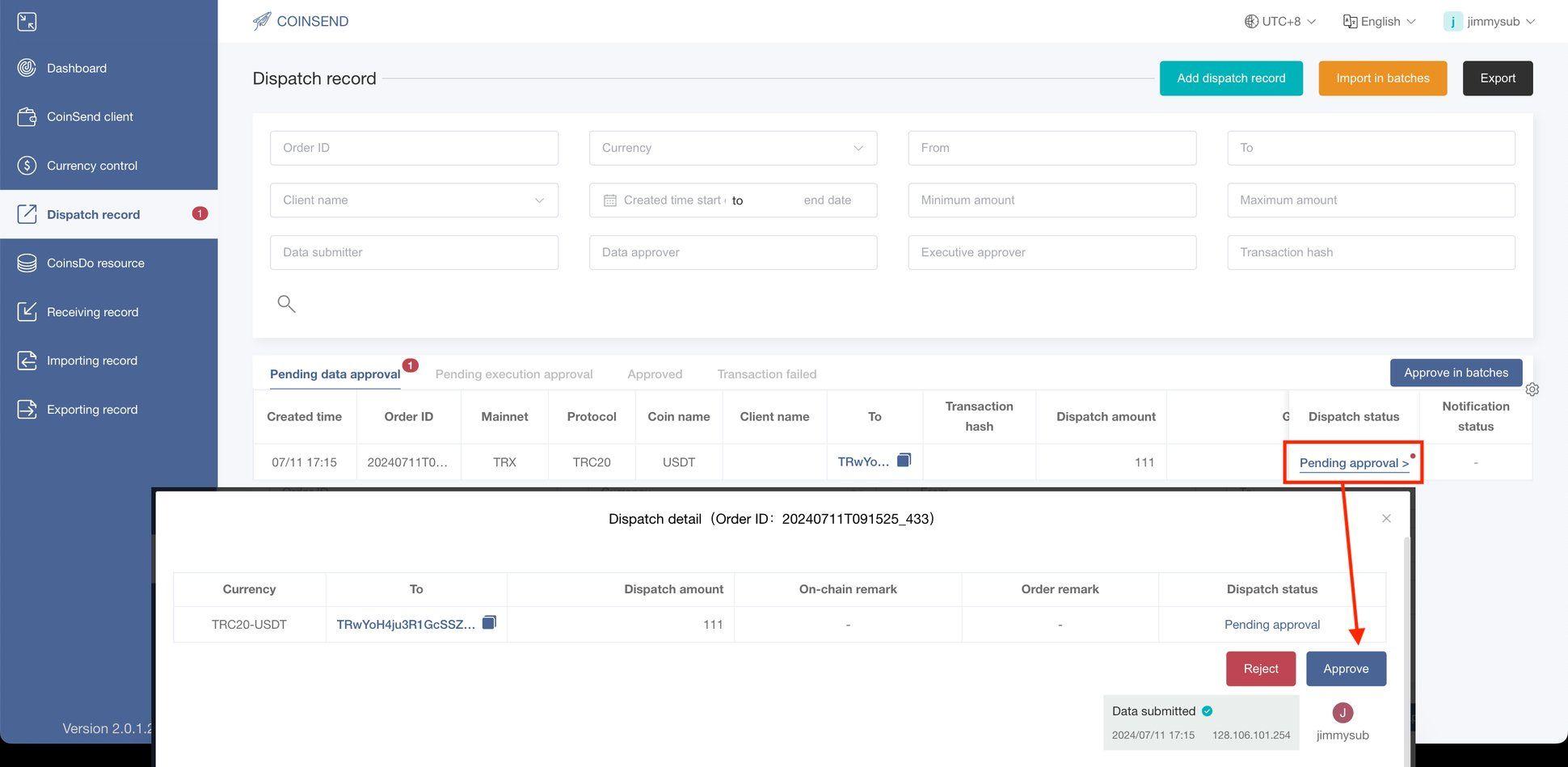
A high-value transfer in CoinSend showing the reviewer and executor signing steps
While no CBDC appears on the CoinsDo supported network list today, adding one leaves the approval logic, the key custody model and the audit trail unchanged. Accounting treatment is a separate exercise, covered in our walkthrough of stablecoin accounting and tax treatment.
Frequently asked questions
Is a CBDC the same thing as a stablecoin? No. A CBDC is a direct liability of a central bank. A stablecoin is a private company's token, backed by reserves it holds. Both can be frozen by their issuer, and only one exists at scale.
Can a stablecoin issuer freeze my tokens? Yes. Circle's risk factors state it reserves the right to block USDC addresses and freeze associated USDC in its sole discretion, and that it may be forced to do so on a legal order from a government authority.
How many countries have actually launched a CBDC? Three. The Bahamas, Jamaica and Nigeria, all still working on domestic adoption. A further 41 pilot projects are running worldwide as of May 2026.
Which is safer for corporate treasury, a CBDC or a stablecoin? A CBDC carries no issuer credit risk, the stronger instrument on paper. A stablecoin carries issuer and reserve risk but is available now. Treasuries needing settlement this year have one option, not two.
Does self-custody protect me from a stablecoin freeze? No. Self-custody means you control the private keys and no provider can lock you out. A stablecoin issuer can still freeze the token at the contract level, whoever holds the keys.
Will CBDCs eventually replace stablecoins for business payments? Nothing in the current data points that way. Central bank work has concentrated on wholesale infrastructure while stablecoin real-economy payments reached $350 to $550 billion in 2025. They are converging on different jobs.
Should I wait for a CBDC before building? No. Build the wallet and approval layer now, attach instruments as they become available, and keep key custody in-house. Waiting costs two years and does not reduce the freeze risk.
The verdict
Build on regulated stablecoins for anything that has to move in the next 24 months, and treat wholesale CBDC as a scheme integration you add later if your central bank actually issues. Retail CBDC does not belong in a two-year plan outside the three launch markets.
Underneath both, hold your own keys. The instrument is a line item you can change in a sprint. The custody model is the one you cannot swap without rebuilding, so it has to be right first time.
See how CoinsDo's Wallet-as-a-Service handles deposits, approvals and withdrawals while you keep the keys.